Why There Won’t Be a Flood of Foreclosures Coming to the Housing Market

November 30, 2022

With the rapid shift that’s happened in the housing market this year, some people are raising concerns that we’re destined for a repeat of the crash we saw in 2008. But in truth, there are many key differences between what’s happening today and the bubble in the early 2000s.

One of the reasons this isn’t like the last time is the number of foreclosures in the market is much lower now. Here’s a look at why there won’t be a wave of foreclosures flooding the market.


Not as Many Homeowners Are in Trouble This Time

After the last housing crash, over nine million households lost their homes due to a foreclosure, short sale, or because they gave it back to the bank. This was, in large part, because of more relaxed lending standards where people could take out mortgages they ultimately couldn’t afford. Those lending practices led to a wave of distressed properties which made their way into the market and caused home values to plummet.

But today, revised lending standards have led to more qualified buyers. As a result, there are fewer homeowners who are behind on their mortgages. As Marina Walsh, Vice President of Industry Analysis at the Mortgage Bankers Association (MBA), says:

“For the second quarter in a row, the mortgage delinquency rate fell to its lowest level since MBA’s survey began in 1979 – declining to 3.45%. Foreclosure starts and loans in the process of foreclosure also dropped in the third quarter to levels further below their historical averages.”

There Have Been Fewer Foreclosures over the Last Two Years

While you may have seen recent stories about the number of foreclosures rising today, context is important. During the pandemic, many homeowners were able to pause their mortgage payments using the forbearance program. The program gave homeowners facing difficulties extra time to get their finances in order and, in many cases, work out a plan with their lender.

With that program, many were concerned it would result in a wave of foreclosures coming to the market. That fear didn’t materialize. Data from the New York Fed shows there are still fewer foreclosures happening today than before the pandemic (see graph below):
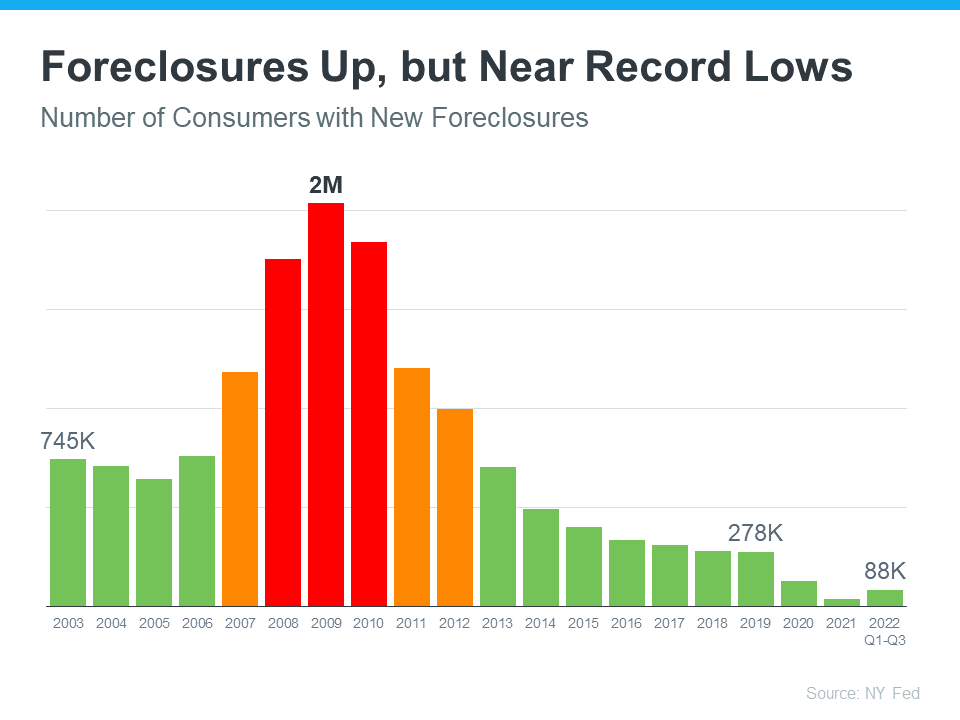
That means, while there are more foreclosures now compared to last year (when foreclosures were paused), the number is still well below what the housing market has seen in a more typical year, like 2017-2019.

And most importantly, the number we’re seeing now is still far below the number we saw during the market crash (shown in the red bars in the graph). The big takeaway? Don’t let a headline in the news mislead you. While foreclosures are up year-over-year, historical context is essential to understanding the full picture.


Most Homeowners Have More Than Enough Equity To Sell Their Homes

Many homeowners today have enough equity to sell their homes instead of facing foreclosure. Due to rapidly rising home prices over the last two years, the average homeowner has gained record amounts of equity in their home. And if they’ve stayed in their homes even longer, they may have even more equity than they realize. As Ksenia Potapov, Economist at First American, says:

“Homeowners have very high levels of tappable home equity today, providing a cushion to withstand potential price declines, but also preventing housing distress from turning into a foreclosure. . . the result will likely be more of a foreclosure ‘trickle’ than a ‘tsunami.’”

A recent report from ATTOM Data explains it by going even deeper into the numbers:

“Only about 214,800 homeowners were facing possible foreclosure in the second quarter of 2022, or just four-tenths of one percent of the 58.2 million outstanding mortgages in the U.S. Of those facing foreclosure, about 195,400, or 91 percent, had at least some equity built up in their homes.”

Bottom Line

If you see headlines about the increasing number of foreclosures today, remember context is important. While it’s true the number of foreclosures is higher now than it was last year, foreclosures are still well below pre-pandemic years. If you have questions, let’s connect.



December 29, 2025
The body content of your post goes here. To edit this text, click on it and delete this default text and start typing your own or paste your own from a different source.
By Brooke Thedford December 8, 2025
And here’s where the mismatch is coming from. A few years ago, you could set any price and buyers would come running, no matter what the price tag said. Odds are, you’d still sell for over asking. But things are different now. Buyers have more options than they’ve had in years, so they can afford to be more selective. If your price feels even a little high to them, it’ll get overlooked in a heartbeat. And for the homeowners who had that happen, some end up pulling their listings instead of making a simple adjustment that could have changed everything. Which is a shame, honestly. Because a small price tweak is usually all it takes to bring buyers in and get the deal done. According to HousingWire , the average price cut right now is just 4%. Think about that. Other sellers are listing too high and giving up rather than dropping their price 4%. If they’d just started 4% lower, they may have already sold. So, before you list, talk to your agent about what’s working nearby. They’ll help you find the sweet spot that’s competitive, realistic, and still protecting your bottom line. And here’s the kicker. If you’ve been in your home for a while, your equity gives you room to set your list price more competitively and still come out way ahead. Unfortunately, those other sellers didn’t seem to realize that. 2. Don’t Rush the Process Another common misstep: expecting your house to sell in a weekend. Many sellers right now remember when homes sold in as little as hours – and they expect that to happen today. But in most markets, that’s not the reality anymore. It takes closer to 60 days to go from listed to sold, which is actually normal (see the gray in the graph below):
December 1, 2025
Affordability is still a challenge. There’s no question about that. But the market has given savvy buyers a head start. Mortgage rates have already come down over the past few months. And the drop we’ve seen saves you more than you’d think. How Much You’ve Already Saved, Without Realizing It Let’s put some real numbers to it. Rates peaked for the year in May when they inched above 7%. But since then, they’ve been slowly declining. Now, they’re sitting in the low 6s. And while that may not sound like a big deal, that change translates to real dollars. According to data coming out of Redfin, the typical monthly payment on a $400,000 home is already down almost $400 since May. That means if you’re buying a home now, you’re saving hundreds of dollars every month compared to what you would have been able to get earlier this spring. That’s real money that makes a real difference for buyers who paused their plans because they thought homeownership was out of reach. And while it may be tempting to wait even longer to see bigger savings, that’s a gamble that could cost you. Here’s why. Where Experts Say Rates Are Headed For starters, most experts say mortgage rates are likely to stay pretty much where we are today throughout 2026. So, there’s no guarantee we’ll see a rate much lower than what we have now. Only one expert forecaster is saying rates could fall into the upper 5s next year (see graph below):
November 3, 2025
Your house needs to stand out and grab attention from day one. That’s especially true when you consider why the number of homes for sale is up. Here’s how it works. Available inventory is a mix of: Active Listings: homes that have been sitting on the market, but haven’t sold yet New Listings: homes that were just put on the market Data from Realtor.com shows most of the inventory growth lately is actually from active listings that are staying on the market and taking longer to sell (see the graph below). The blue bars show active listings. These are the homes that are sitting month to month and not selling. The green bars are new listings, the homes that were just put on the market. And it’s clear there are fewer new listings compared to how many are staying on the market unsold.
October 31, 2025
Monthly Payments Are Coming Down One of the clearest signs of this shift is in monthly payments. The latest data from Redfin shows mortgage payments on a median-priced home are now $283 lower than they were just a few months ago (see graph below):
October 31, 2025
More Homes Will Sell With all of the affordability challenges at play over the past few years, many would-be movers pressed pause. But that pause button isn’t going to last forever. There are always people who need to move. And experts think more of them will start to act in 2026 (see graph below):
By Brooke Thedford October 20, 2025
Why Builders Are Throwing in Perks There are more newly built homes for sale right now than there have been in years. And as a buyer, that can help you in two big ways. It gives you more options to choose from on the market, and it motivates builders to sell their inventory before they build more. That’s exactly why more buyers are scoring incentives like these: - Mortgage rate buydowns to shrink your monthly payment - Price cuts that make homeownership more attainable - Help with closing costs and even upgrades in some communities The best part is, a lot of builders are offering these perks right now. According to Zonda, nearly 6 out of 10 new home communities are doing incentives on to-be-built homes. And over 75% are doing the same for quick move-ins, which are homes that are already built and ready to move into. As real estate analyst Nick Gerli explains: “. . . builders are adjusting to the realities of the current housing market. They’ve cut prices 13 percent from peak, and are giving generous mortgage rate buydowns on top of that.” The big takeaway is: builders are motivated to sell. So, you could snag a lower price and maybe even a lower mortgage rate if you buy new. If you’ve been feeling priced out, these offers might be your way back in. You Have More Brand-New Options Than Normal Since there are more new homes on the market than usual, that gives you more options than you’ve had in years. Whether you’re looking for something turnkey or want to personalize a build, odds are there’s more available near you than you may realize. Even though the number of new homes for sale is up throughout the country, there are pockets where you have an even better chance to find a better price. According to Census data, here’s a high-level look at which parts of the country are seeing the biggest boost in newly built homes (see graph below):
October 13, 2025
What the Data Really Shows While we've definitely seen prices moderate from the rapid and unsustainable climb in 2020-2022, how much they've changed is going to be different everywhere. If you look at data from ResiClub and Zillow for the 50 largest metros, this becomes very clear. The real story is split right down the middle. Half of the metros are still seeing prices inch higher. The other half? Prices are coming down slightly (see graph above). The big takeaway here is flat doesn't mean prices are holding steady everywhere. What the numbers actually show is how much price trends are going to vary depending on where you are. One factor that's driving the divide? Inventory. The Joint Center for Housing Studies (JCHS) of Harvard University explains: ... price trends are beginning to diverge in markets across the country. Prices are declining in a growing number of markets where inventories have soared while they continue to climb in markets where for-sale inventories remain tight. When you average those very different trends together, you get a number that looks like it's flat. But it doesn't give you the real story and it's not what most markets are feeling today. You deserve more than that. And just in case you're really focusing on the declines, remember those are primarily places where prices rose too much, too fast just a few years ago. Prices went up roughly 50% nationally over the past 5 years, and even more than that in some of the markets that are experiencing a bigger correction today. So, a modest drop in some local pockets still puts most of those homeowners ahead when it comes to the overall value of their home. And based on the fundamentals of today's housing market, experts are not projecting a national decline going forward. So, what's actually important for you to know? If You're Buying You need to know what's happening in your area because that's going to influence everything from how quickly you need to make an offer to how much negotiating power you'll have once you do. In a market where prices are still inching up, waiting around could mean paying more down the line. In a market where they're easing, you may be able to ask for things like repairs or closing cost help to sweeten the deal. The bottom line? Knowing your local trend puts you in the driver's seat. If You're Selling You'll want to be aware of local trends, so you'll know how to price your house and how much you can expect to negotiate. In a market where prices are still rising, you may not need to make many compromises to get your home sold. But if you're in a market where prices are coming down, setting the right price from the start and being willing to negotiate becomes much more important. The big action item for homeowners? Sellers need to have an agent's local perspective if they want to avoid making the wrong call on pricing and homes that are priced right are definitely selling. The Real Story Is Local The national averages can point to broad trends, and that's helpful context. But sometimes you're going to need a local point of view because what's happening in your zip code could look different. As Anthony Smith, Senior Economist at Realtor.com, article puts it: While national prices continued to climb, local market conditions have become increasingly fragmentedThis regional divide is expected to continue influencing price dynamics and sales activity as the fall season gets underway. That's why the smartest move, whether you're buying or selling, is to lean on a local agent who's an expert on your market. They'll have the data and the experience to tell you whether prices in your area are holding steady, moving up, or softening a bit and how that could impact your move. Bottom Line Headlines calling home prices flat may be grabbing attention, but they're not giving you the full picture. Has anyone taken the time to walk you through what's happening in your market? If you want the real story about what prices are doing in your area, connect with a local agent.
By Brooke Thedford June 17, 2025
Some Highlights: Have you been holding off on downsizing? If so, you should know your equity could make your move possible. Homeowners today have so much equity that a record number are buying their next house in all cash. And that has some big benefits like making their offer more appealing, potentially closing faster, and not having a mortgage payment. To find out how much equity you have in your current house, connect with a local agent. Because it may be enough to fuel your move.
More Posts